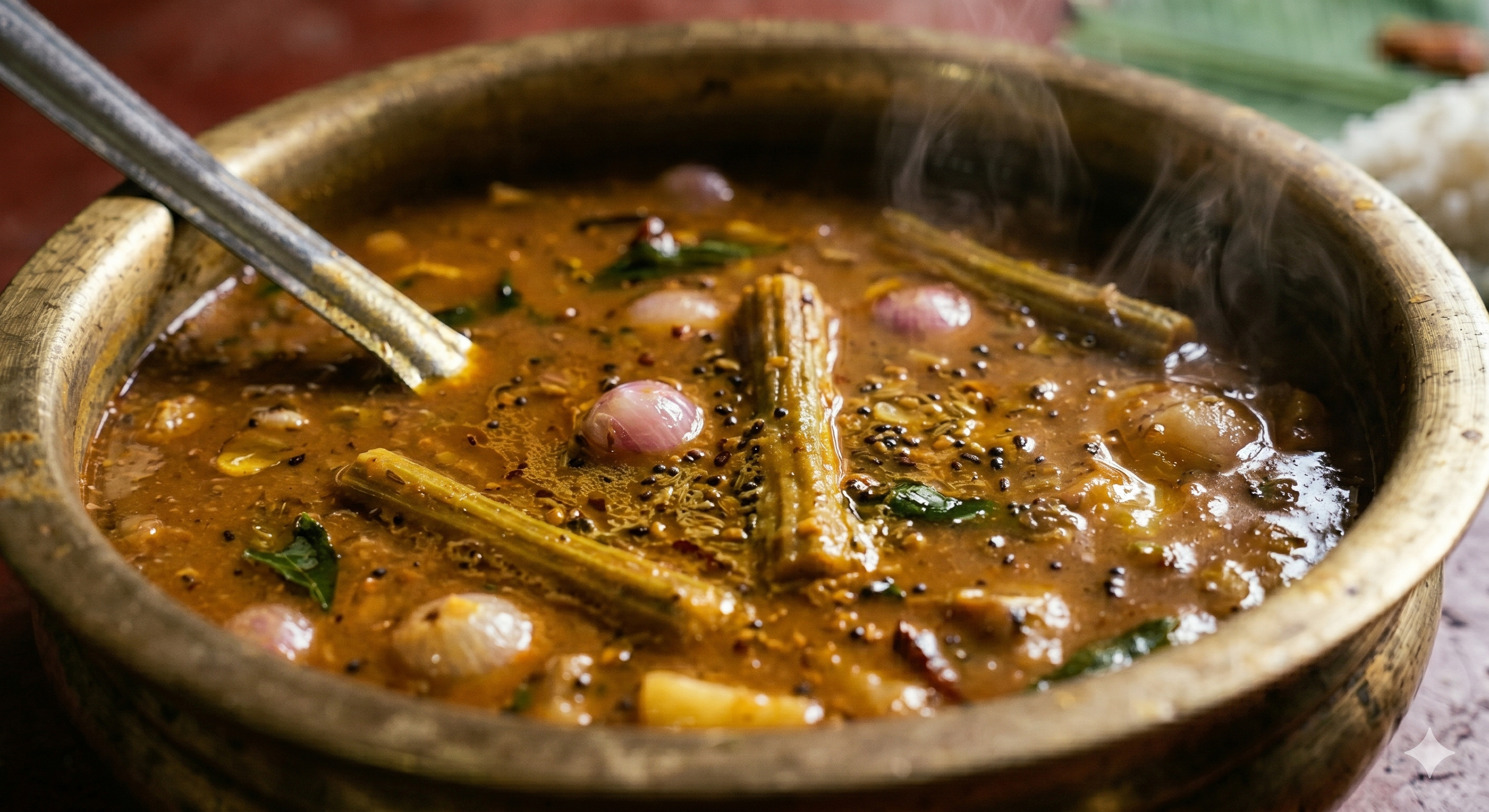
My father makes sambar exactly once a week. Sunday mornings, always. He starts at seven, which means the first smell of mustard seeds crackling in ghee reaches wherever you are sleeping at around seven fifteen. It is a reliable alarm clock and a better one than most.
He does not follow a written recipe. He has never written one down. What he follows is a sequence — a particular order of operations that he would be unable to justify academically but that produces the same result every time. I have watched it enough times to reconstruct it. The sequence is the recipe.
The thing about this sambar is that it cannot be rushed. Not in the way that most recipes say "cannot be rushed" as a polite suggestion. This one genuinely falls apart if you try to compress the time. The dal needs to be fully cooked down to the point where it dissolves into the liquid and thickens it from inside. The tomatoes need to collapse. The tamarind needs to lose its edge. These things take the time they take.
is always slightly more
than you think it should be.
He taught me that. I have tested it. He is right.
The recipe
- 150g toor dal (split pigeon peas)
- 3 medium tomatoes, roughly chopped
- 1 medium onion, roughly chopped — not fine, you want texture
- 2 drumsticks, cut into 3-inch pieces (or a handful of shallots)
- 1 small ball tamarind, soaked in 2 cups warm water for 20 min
- 2 tsp sambar powder (homemade if possible)
- 1 tsp coriander seeds
- ½ tsp cumin seeds, divided
- ¼ tsp turmeric
- 2 dried red chillies
- Curry leaves, mustard seeds, salt
- 2–3 tsp ghee (the correct amount is always slightly more than you think)
- Mustard seeds
- 2 dried red chillies
- Curry leaves
- Pinch of asafoetida (hing)
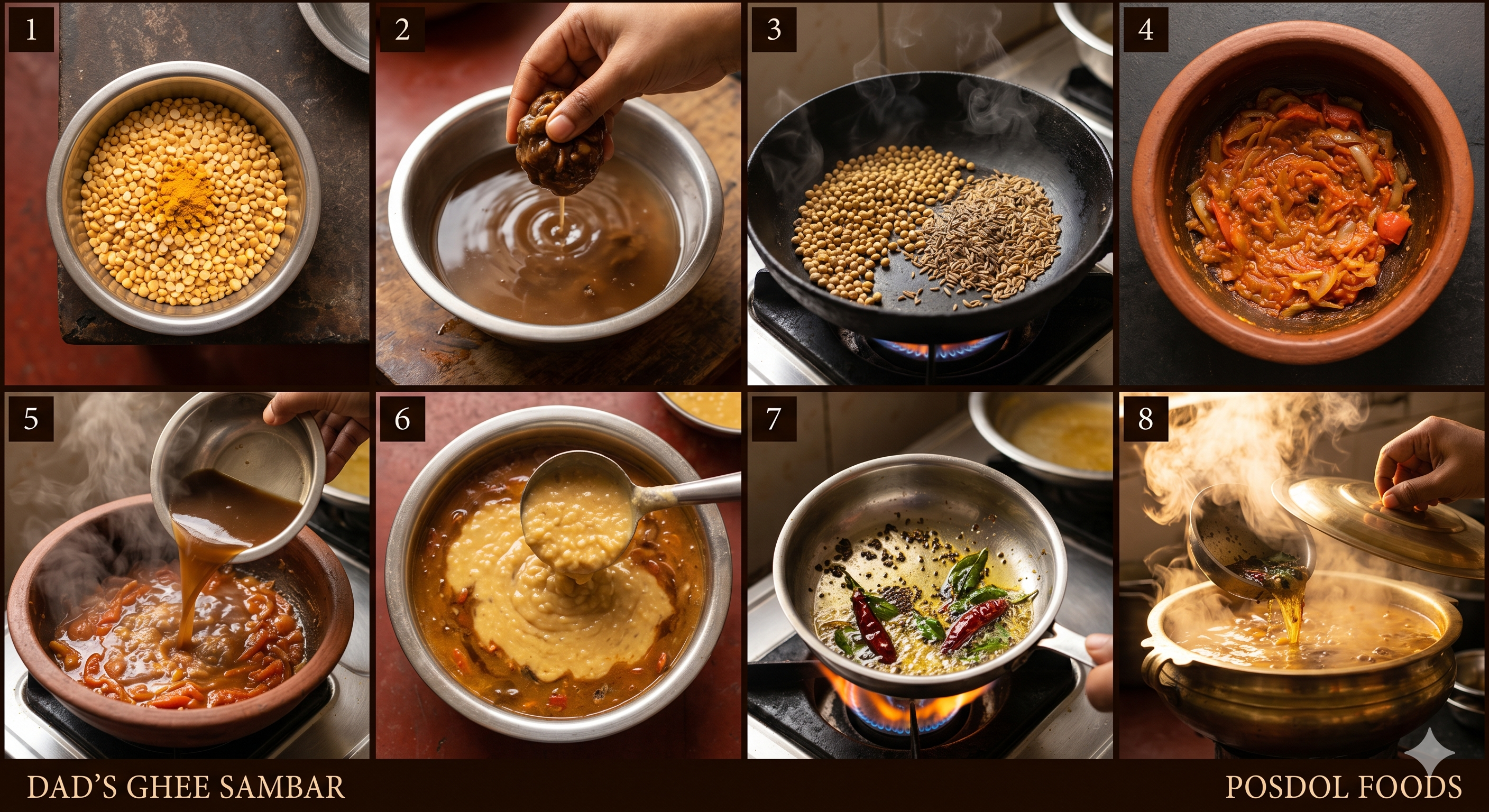
- Soak the tamarind. Place tamarind in 2 cups warm water for 20 minutes. Squeeze the pulp in with your fingers until dissolved, then strain through a sieve. Keep the liquid, discard the fibres.
- Cook the dal — properly. Wash toor dal until water runs clear. Pressure cook or simmer with turmeric and 2 cups water until completely soft — beyond soft. Thick porridge consistency, no whole dal visible. Pressure cooker: 15–20 min. Stovetop: 40 min minimum.
- Dry roast the spices. In a large heavy pot, dry roast coriander seeds and half the cumin seeds for 2 minutes until fragrant. Grind coarsely. Set aside.
- Build the onion-tomato base. In the same pot, heat a small amount of oil. Add remaining cumin seeds and let them crackle. Add the onion; cook 8 minutes until soft and beginning to colour. Add tomatoes; cook until completely collapsed, about 10 minutes. Do not rush — the result should be a thick, jammy paste, not a chunky sauce.
- Simmer with tamarind. Add sambar powder and the ground coriander-cumin mixture. Cook, stirring, for 2 minutes. Add drumstick pieces and tamarind water. Bring to a boil, then simmer 15 minutes until the drumstick is fully cooked and the raw edge of the tamarind has softened.
- Add the dal and finish. Add cooked dal to the tamarind base and stir to combine. Sambar should be loose — it thickens as it cools. Salt generously. Simmer together for 10 minutes so everything settles into itself.
- Make the ghee tadka. In a small pan, heat ghee until shimmering. Add mustard seeds — when they pop, add dried red chillies, asafoetida, and curry leaves. Stand back when the curry leaves hit the ghee. They will spit.
- Seal the tadka in. Pour the tadka directly into the sambar. Cover the pot immediately and leave for 2 minutes before stirring. The sealed steam carries the flavour in — do not skip this step.
What the recipe is actually teaching
There are better technical sambar recipes. There are versions with more layers of spice, versions that use fresh coconut, versions from specific regions that will taste different and arguably more complex.
This is not that version. This is the version where the teaching is in the time. In the understanding that you cannot shortcut dal by undercooking it and expecting the sambar to compensate. In the understanding that a tadka poured into a covered pot works differently than one left to dissipate in an open pan.
My father did not explain any of this to me. He does not teach through explanation. He teaches through watching. I watched this sambar made every Sunday for years before I tried to make it myself, and when I did, the first thing I noticed was that I was impatient in a way he never was. I was trying to compress Sunday into forty-five minutes instead of the ninety it needed.
The sambar told me. It tasted like something that had been made quickly. Which it had.
There is no technique in this recipe that is difficult. The only difficult thing is not rushing it. That is also the teaching.